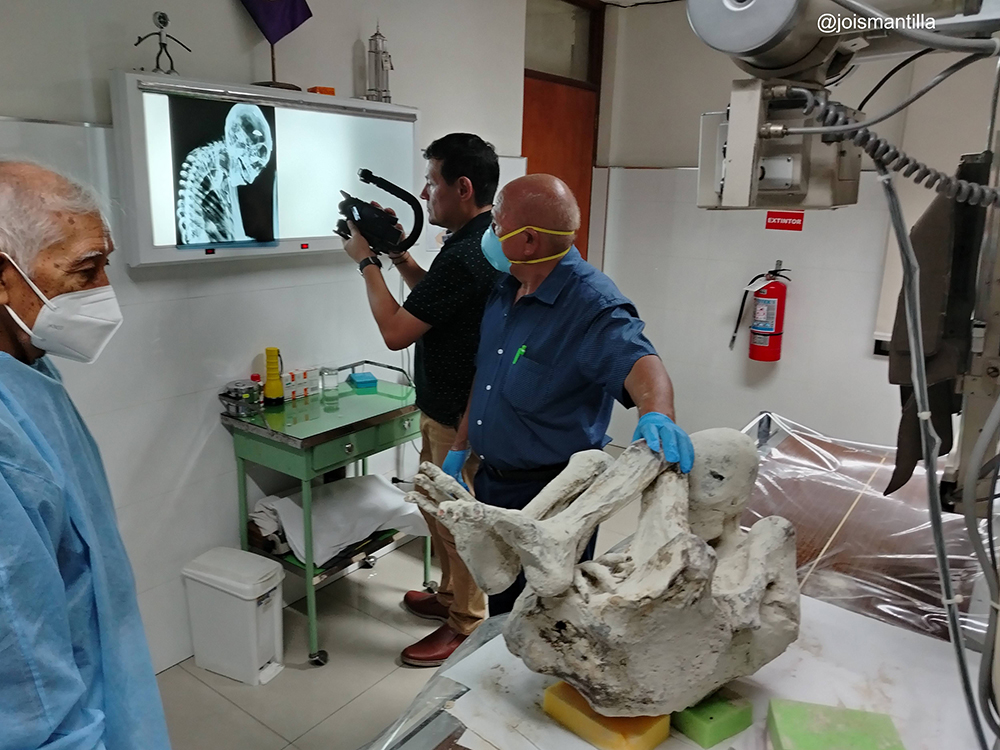
Status update: the specimens remain in the custody of the National University San Luis Gonzaga of Ica while the Ministry of Culture evaluates declaring them cultural heritage assets. Public visitor access will be enabled once that official declaration is granted.
The specimens are now safeguarded at UNICANational University “San Luis Gonzaga” of Ica is preparing the preservation, maintenance, and security conditions. The collection is not yet open to the public.
The tridactyl beings are finally under the custody of the National University “San Luis Gonzaga” of Ica, which is working to improve their preservation conditions. The university has also officially requested that all of the desiccated bodies be registered as Cultural Heritage with Peru’s Ministry of Culture, just as was previously done for “María” and “Wawita”.
This is a collective achievement made possible through the efforts of the members of Inkari-Cusco, Tercer Milenio, radiologists, biologists, forensic specialists, geneticists, anthropologists, archaeologists, physicians, professors, researchers, and science communicators from many countries. Each has contributed selflessly to help reach this new milestone in the protection and investigation of this valuable world heritage.
WE ARE WHAT WE PROTECT.
Thank you all. 🖖🏻💀🖖🏻💀
Research update
The Discovery, Now
Dr. Zúñiga answers five questions about the newly arrived specimens, the research underway, and what comes next.
5 questions Bilingual
i
Dr. Zúñiga’s Spanish responses are preserved with only minimal spelling and grammar corrections. The English version has been translated and lightly edited for clarity.
Clinical study
Dr. Zúñiga and Dr. Mendoza studying the pregnant tridactyl specimen, Montserrat.
01
When did the new specimens arrive at the National University San Luis Gonzaga of Ica?
Dr. Zúñiga
On January 30, 2026, six humanoid specimens and other objects were formally delivered to the National University San Luis Gonzaga of Ica, documented by an official transfer record.
02
Now that all the bodies are at the university, what is the project’s next stage?
Dr. Zúñiga
Research is continuing with the new bodies. Current work includes imaging techniques such as radiography, CT scanning, and other examinations. DNA analysis and carbon-14 (C14) dating are also underway in collaboration with a prestigious university.
03
Does the project currently have the support of the university authorities?
Dr. Zúñiga
Yes. The senior leadership of the National University San Luis Gonzaga of Ica has expressed strong interest in the institution’s continued custody of the specimens and in advancing the research process.
04
How many university professors currently participate in or support the project?
Dr. Zúñiga
The team originally included 15 professors. Following the deaths of two members, 13 specialists from different disciplines remain involved. Most come from medical fields, and this breadth of expertise strengthens the research process.
05
Is there anything else you would like the public to know about the specimens or the future of the research?
Dr. Zúñiga
“We will soon have very surprising news as a result of the research process. Best regards.”
Major update video
Learn more about this important development
YouTube
CC
Watching in English?
On YouTube, choose English subtitles. If English is not listed, select Auto-translate → English, or use the AI-dubbed English audio when available.
What this segment covers
01
A tour of the facilities
See the university facilities and the full collection of specimens now in its custody.
02
First-time reveals
Never-before-seen specimens and artifacts are shown publicly for the first time.