
Fingerprints
Human Fingerprints
Human fingerprints are intricate patterns that have evolved over millions of years, showcasing unique designs such as arches, loops, and whorls. These patterns develop during embryonic growth, guided by a Turing reaction-diffusion system involving signaling molecules like EDAR, WNT, and BMP, as outlined in a recent study The developmental basis of fingerprint pattern formation and variation. This complexity arises from a blend of genetic and environmental influences, ensuring each human fingerprint remains distinct.
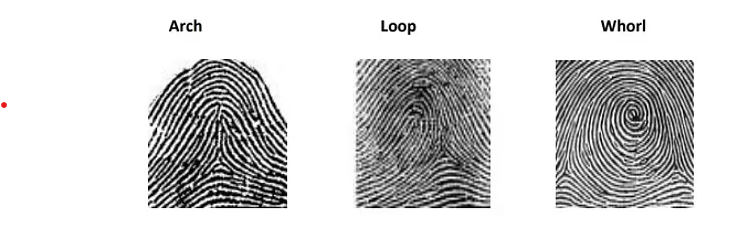
Examples of Human Fingerprint Patterns: Arches, Loops, and Whorls
Tridactyl Fingerprints
So far, we have found some tridactyls that unlike humans display straight-line fingerprint and toeprint patterns. These linear ridges lack the curves and swirls seen in human prints, appearing as parallel or nearly parallel lines across their digits. This simplicity points to a distinct developmental process or evolutionary origin.
Dr. David Ruiz Vela's Explanation
Below is a video from Dr. David Ruiz Vela explaining why the straight-line fingerprint patterns observed in tridactyl beings serve as evidence that they are not human. The absence of typical human fingerprint characteristics, such as loops, whorls, and arches, suggests a fundamentally different biological origin.
Differences and Why It Matters
The difference between human and tridactyl fingerprints lies in their complexity: human prints boast dynamic, swirling patterns, whereas tridactyl prints remain starkly linear. This distinction is crucial in forensic science, where fingerprint classification, established in the U.S. in 1902 with arches, loops, and whorls, depends on pattern intricacy to identify individuals. Straight-line tridactyl prints, missing these traits, suggest a non-human source, assisting in species differentiation and evolutionary research.
Tridactyl Fingerprints Gallery
Maria`s Fingerprints
Santiago`s Toeprints
Paloma`s Fingerprints
Paloma's fingerprints appear to have been destroyed, damaged, or are still covered, making detailed analysis challenging.